

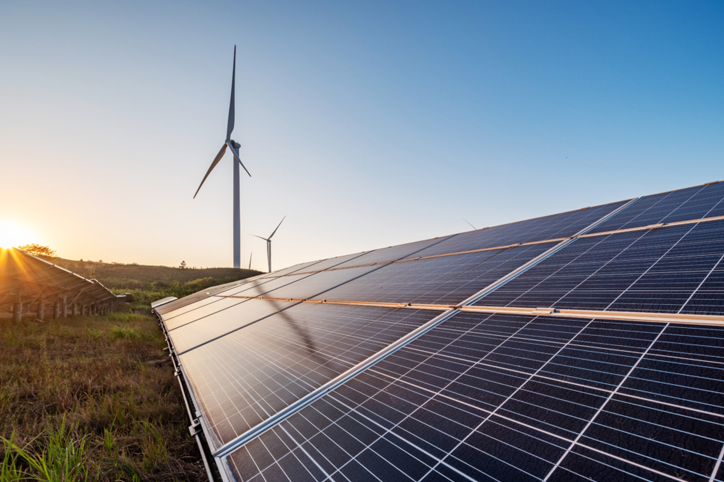
Renewable energy sources are at the center of global discussions on sustainability and climate change mitigation. Technologies based on natural resources—such as solar radiation, wind, water, biomass, and geothermal heat—play a fundamental role in reducing greenhouse gas emissions and promoting the decarbonization of the global economy.
Despite their significant potential, the transition toward renewable energy sources is a complex and gradual process, involving technical, economic, regulatory, and infrastructure-related challenges.
This article presents the main types of renewable energy sources, highlighting their characteristics, benefits, limitations, and their role within the global energy transition.
What are renewable energy sources?
Renewable energy sources are those capable of natural regeneration or continuous availability, without risk of depletion on a human time scale. They differ from non-renewable sources—such as oil, coal, and natural gas—which have finite reserves and generally higher environmental impacts associated with their extraction and use.
On the other hand, renewable sources are strongly influenced by environmental factors, including climate conditions, seasonality, and geographical availability, which affect their predictability and integration into energy systems.
The main renewable energy sources include:
Solar energy
Solar energy harnesses radiation from the Sun to generate electricity and heat and is one of the fastest-growing renewable energy sources worldwide.
According to the International Renewable Energy Agency (IRENA), solar power accounted for approximately 73% of global renewable capacity expansion in 2023.
Solar energy conversion occurs primarily through two technologies:
-
Photovoltaic energy: solar panels directly convert sunlight into electricity;
-
Solar thermal (concentrated solar power): uses solar heat for direct heating or to generate steam and drive turbines in large-scale power plants.
Main benefits:
-
Virtually inexhaustible energy source;
-
Low emissions during operation;
-
High flexibility, suitable for both urban and rural applications.
Main challenges:
-
Intermittency associated with day–night cycles and weather conditions;
-
Initial investment costs, although significantly reduced in recent years.
Wind energy
Wind energy converts the kinetic energy of wind into electricity through wind turbines. It is currently the second-largest renewable energy source in terms of installed global capacity.
In 2023, wind power accounted for approximately 24% of global renewable energy growth (IRENA, 2024).
In addition to onshore wind farms, offshore wind projects have gained prominence, such as the Hornsea Project in the United Kingdom. In Brazil, favorable wind regimes—particularly in the Northeast and South regions—have positioned the country as a global reference in wind energy generation.
Main benefits:
-
Clean and widely available in regions with consistent wind resources;
-
Natural complementarity with solar energy;
-
High efficiency in suitable locations.
Main challenges:
-
Variability in power generation due to wind fluctuations;
-
Visual impact and land-use planning considerations.
Hydropower
Hydropower is one of the oldest and most established renewable energy sources, currently accounting for approximately 16% of global electricity generation.
Its operating principle is based on converting the potential energy of stored water into mechanical energy and subsequently into electricity through turbines and generators.
In addition to large hydroelectric plants, Small Hydropower Plants (SHPs) are being promoted as lower-impact alternatives with greater regional integration.
Main benefits:
-
High efficiency and operational reliability;
-
Energy storage capability through reservoirs;
-
Low operational emissions.
Main challenges:
-
Environmental and social impacts associated with dam construction;
-
Dependence on hydrological regimes, increasing vulnerability to droughts.
Biomass
Biomass energy uses organic matter—such as agricultural, forestry, and urban residues—to generate energy. In addition to being renewable, it supports waste recovery and contributes to the circular economy.
In Brazil, the use of sugarcane bagasse for power generation and biogas production is particularly significant, integrating the energy sector with the sugar–energy industry.
Biomass can be classified into:
-
Solid biomass: wood, agricultural residues, charcoal;
-
Liquid biofuels: ethanol, biodiesel;
-
Gaseous fuels: biogas and methane from controlled decomposition of organic waste.
Main benefits:
-
Reduction of organic waste;
-
Applicability in both urban and rural contexts;
-
Integration with existing production chains.
Main challenges:
-
Risk of deforestation if poorly managed;
-
Emissions associated with combustion and conversion processes;
-
Complex logistics for transportation and storage.
Geothermal energy
Geothermal energy exploits heat stored within the Earth and is highly reliable in regions with significant geological activity.
Countries such as Iceland, Kenya, and Japan lead its application, both for electricity generation and direct heating.
Main benefits:
-
Continuous energy production independent of weather conditions;
-
High efficiency in suitable geological settings;
-
Direct-use applications for residential and industrial heating.
Main challenges:
-
Limited feasibility to geologically favorable regions;
-
Potential for induced seismic activity associated with subsurface operations;
-
High upfront investment costs.
Ocean energy: waves and tides
Ocean energy harnesses the movement of waves, tides, and marine currents to generate electricity. Although still under development, it presents significant potential, particularly for coastal countries.
Pilot projects, such as Swansea Bay in the United Kingdom, are assessing its technical and economic feasibility.
Main benefits:
-
High predictability, especially for tidal energy;
-
Broad global availability;
-
Reduced visual impact compared to onshore renewable installations.
Main challenges:
-
Harsh marine environments, with corrosion and extreme loading conditions;
-
Site-specific energy potential;
-
Need for careful assessment of marine ecosystem impacts.
Why are renewable energy sources essential?
Rising global temperatures and the increasing frequency of extreme climate events make the expansion of renewable energy sources indispensable. The decarbonization of the global economy depends directly on these technologies to enable a lower-impact energy system.
Key benefits include:
-
Reduction of greenhouse gas emissions;
-
Preservation of natural resources and ecosystems;
-
Long-term energy security;
-
Economic development and technological innovation.
The challenge of the energy transition
Despite significant progress, fossil fuels still account for more than 80% of the global energy mix. According to the International Renewable Energy Agency (IRENA), in 2023, renewable energy growth reached a record 473 GW, led by China and other Asian countries, while regions such as Africa experienced limited expansion.
The energy transition requires:
-
Large-scale infrastructure investments;
-
Advances in energy storage technologies;
-
Effective public policies and international cooperation.
Technologies and strategies for decarbonization
Carbon credits
Carbon credit mechanisms help offset residual emissions by supporting environmental conservation and sustainable development projects.
CCUS – Carbon Capture, Utilization, and Storage
CCUS technologies enable the capture of CO₂ from industrial processes and its reinjection into subsurface formations, reducing emissions and, in some cases, enhancing the productivity of mature oil fields.
Conclusion: renewable energy sources
The future global energy system will be based on a combination of multiple energy sources, with renewables playing a central role. Achieving carbon neutrality by 2050, as established under the Paris Agreement, depends on expanding renewable energy deployment and gradually reducing reliance on fossil fuels.
Decarbonization is an inevitable pathway that requires innovation, engineering, planning, and global collaboration.
CRN’s role in renewable energy
For more than a decade, CRN Engenharia has supported companies in the energy sector in the development and assessment of renewable energy solutions, integrating engineering expertise, innovation, and technical analysis to reduce emissions and improve operational efficiency.
Our experience enables us to contribute strategically to complex projects, aligning technical performance, sustainability, and economic viability.